Skip to content
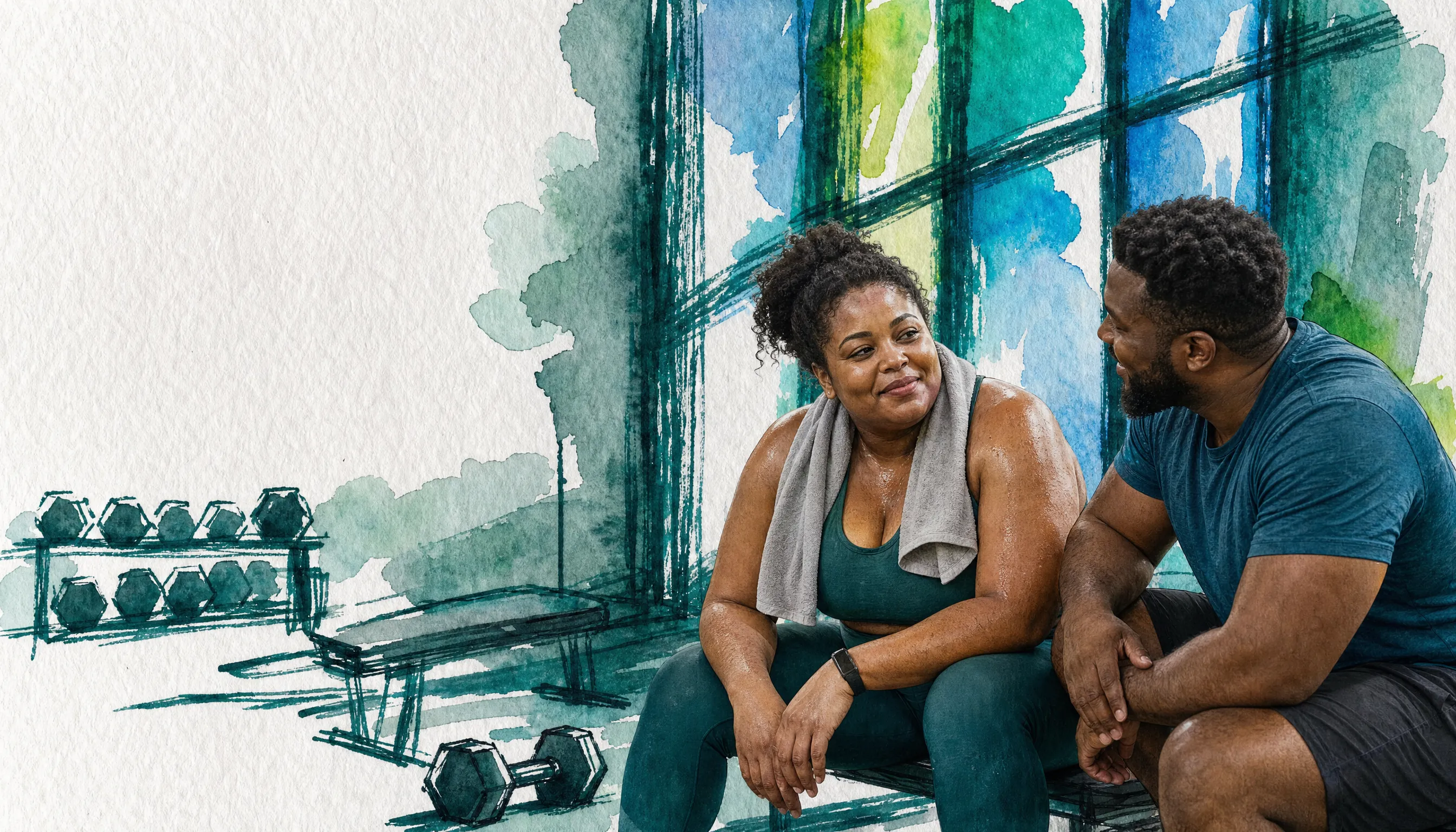
Ink-wash drawing of a person part-way through standing up from a low bench in a plain room, one hand braced on a knee, two light dumbbells on the floor beside them.
Strength

Holding onto the muscle while the weight comes off

Everyone says you will lose muscle along with the weight. There is a printed floor for holding onto it, and most people assume it means more walking. Here is what actually counts as one of those days, and what to raise with a clinician first.
Dr. Marcus Bell · Sep 8, 2026 · 5 min

This article is general information about medical weight care. It is not medical advice and it is not a substitute for care from a licensed clinician who knows your history. Compounded medications are not FDA-approved and are not reviewed by the FDA for safety, effectiveness or quality. NicoCares is not affiliated with, and is not endorsed by, the makers of any branded medication named here. Individual results vary, and a physician may decide that treatment is not appropriate for you.

You are losing weight with a physician's help, and someone has told you that part of what comes off will be muscle — a relative, a trainer, a comment under a video. Last week you put a hand on a chair to get up off the floor, and the warning stopped being theoretical. There is a floor for what holds onto muscle while weight comes off, it is printed in the federal activity guidelines, and it is smaller than most people assume. You can settle your own week against it in about a minute, by counting sessions rather than steps.

Some of the weight you lose is lean tissue rather than fat, and that happens during the losing rather than after it, so now is when the work counts. Adults need muscle-strengthening activity at least 2 days each week, working all the major muscle groups. Walking counts toward a different target. Two days is a floor rather than a goal.

Why muscle comes off along with the fat

Muscle comes off along with the fat because a calorie deficit draws on lean tissue as well as fat stores, and the deficit on its own does nothing to steer the split between them. Resistance work steers it. Across six randomized trials pooled in Nutrients in 2018, older adults with obesity who added resistance training to a calorie deficit kept nearly all of the muscle the deficit would otherwise have taken, and lost as much fat and as much weight as the groups on the deficit alone.

Age changes what that loss costs you. Lean body mass falls on its own as you get older: muscle changes often begin in the 20s in men and in the 40s in women, muscle fibers shrink, and lost muscle tissue is replaced more slowly than it once was. Losing weight in your fifties therefore takes muscle from a smaller supply than losing the same weight in your thirties, and strength falls with the mass. That is the part you feel on the way up off the floor.

Two days a week, and what counts as one

One day counts when the work covers all the major muscle groups — legs, hips, back, abdomen, chest, shoulders and arms — and two of those days in a week is the floor. The two do not have to look alike, and neither has to happen in a gym.

What qualifies is a wider list than most people picture: lifting weights, working with resistance bands, body-weight moves such as push-ups and sit-ups, digging in a garden, and some yoga postures are all on it. There is a printed test for whether a set did anything, which is to repeat the movement to the point where it is hard to do another repetition without help. Eight to twelve repetitions makes one set, one set brings benefit, and two or three bring more.

Walking is not on that list, which is how a week that feels active turns out to be sitting at zero. Steps count toward the aerobic half of the guidelines, a separate target with its own number, and a daily walk moves nothing on this half at all.

Eating enough feeds the same outcome, and if meals are getting skipped because nothing appeals, eating enough when you are not hungry is its own problem with its own answer.

When to check with a clinician first, and what to ask

Check with a clinician first if you have a chronic health condition or a disability — those are two among the reasons the same page prints for asking before you start. The question to put to them is which types and amounts of activity fit you, and consulting a health care professional or physical activity specialist about exactly that is the printed advice. The recommendation itself does not shrink for you: 2 days a week, all the major muscle groups.

If you have heart disease, talk with your provider before the first session, and carry the printed list of signs that mean stop: dizziness or lightheadedness, chest pain, an irregular heartbeat or pulse, shortness of breath, and nausea. Pain, pressure, tightness or heaviness in the chest, arm, neck or jaw, and numbness in your arms, are a call to your provider rather than something to rest off.

If nothing on your record raises a question, one is still worth asking at your next appointment: whether the trouble you are having getting up is muscle, a joint, or something else. Nobody can answer that from a guideline, and the answer changes what your two days look like.

Two days, and how to pick them

  • Pick two days and write them down. Any two will do, including the days you already walk.
  • On each of them, work all seven major muscle groups: legs, hips, back, abdomen, chest, shoulders and arms.
  • Take each movement to the point where another repetition would be hard without help. Eight to twelve of them makes a set.
  • Start at one set per movement, and add a second when the first stops being hard.
  • If you have a chronic condition, a disability or heart disease, ask a clinician which types and amounts fit you before you start.
  • Managed one day instead of two? Keep the one. Some physical activity is better than none.

The two days will not tell you how the week went. Muscle held onto is invisible from the outside and invisible on the scale, and the thing you can check instead is function: whether the stairs, the groceries and getting up off the floor are getting easier. The trials that measured muscle kept were run in older adults with obesity training under supervision, a narrower group than everyone reading this. The two-day floor is written for all adults, and it is the one to hold your own week to.
Questions people ask

Do I need a gym or any equipment for this?
No. Lifting weights, working with resistance bands, body-weight moves such as push-ups and sit-ups, digging in a garden and certain yoga postures are all named as muscle-strengthening activity. What makes a day count is the muscle groups covered and the effort reached, not the room it happens in.
Can strength work go on the same day as my walk?
Yes. The aerobic and muscle-strengthening recommendations are counted in days per week and are not required to fall on separate ones, so a walk and a strength session can share a day. Two days a week is a count of days, not a schedule.
Should I drop my walks and do strength work instead?
No. The two are separate recommendations and one does not discharge the other, so the two strength days are added to what you already do rather than swapped in for it. Walking still counts toward the aerobic half in full.
Is it too late to start once the weight is already off?
The 2-days-a-week floor is written for all adults with no window attached to it, and lean body mass declines with age whatever you weigh, so there is no point at which starting stops being worth it. What changes after the weight is off is only that you are no longer in a calorie deficit at the same time.

Not sure where to start? Let the intake guide you.

Reviewed by Dr. Arjun Patel
Written by

Dr. Marcus Bell

A NicoCares physician. Illustrative demo content.
More in the Journal

Keep reading

An ink-wash drawing of a tall glass of water with a sprig of mint, standing on a plain kitchen table beside a folded cloth.
Eating

When constipation stops being a nuisance and starts being worth a call

The printed threshold you can hold your own pattern against, why smaller meals move a bowel habit when nothing else has changed, and the two lists of symptoms — one that means call your provider this week, one that means be seen today.Dr. Grace Lin · Sep 8, 2026 · 6 min read
Ink-wash still life of a glass of water and a few plain crackers on a small plate at the edge of a kitchen table, barely touched.
Eating

Eating enough when you are not hungry at all

A way to check one day of eating on paper instead of guessing at it, the question at the table that separates not wanting food from not being able to eat, and the two things that turn a quiet appetite into a call rather than another week.Dr. Arjun Patel · Sep 8, 2026 · 6 min read
Ink-and-wash interior: a woman sitting by a window with a mug of tea, a wall calendar beside her with several dates circled unevenly across two months.
Life stage

Irregular periods for years, and whether to settle it before you start

The three diagnostic features and how many of them you need, the blood tests that rule other conditions out first, and the one thing to settle at the same appointment whatever the result turns out to be.Dr. Ruth Adler · Sep 8, 2026 · 6 min read
Collage of a hospital corridor: a gowned patient on a trolley waiting outside a set of double doors, two staff in scrubs talking beside a wall-mounted clock.
Treatment

Telling a surgeon, a dentist or an endoscopy team what you take

Three separate teams decide things about you between the booking and the date, and none of them automatically knows what you take. Here is who to tell, when, and what changes if the first anyone hears is on the morning.Dr. Ruth Adler · Sep 5, 2026 · 6 min read
An ink-and-watercolor illustration of a couple on a hospital bed: a woman in a gown holds a swaddled newborn in a knitted cap against her chest, and a man leans his head against hers, both with their eyes closed.
Life stage

Planning a pregnancy, finding out you already are, and what the pill does in the meantime

Which contraceptive instruction is printed for which medicine, how far ahead of trying to conceive one of the two labels tells you to stop, and what to say the day a test comes back positive.Dr. Ruth Adler · Sep 8, 2026 · 7 min read
An ink-and-watercolor illustration of a clinician in a white coat with a stethoscope, mid-sentence at a desk, one hand raised as she talks to an open laptop during a video visit.
Treatment

The pain on the right side when weight is coming off fast

What connects fast weight loss to gallstones, what a gallbladder attack feels like next to bad indigestion, and the two printed lists that separate a message in the morning from an emergency room tonight.Dr. James Whitfield · Sep 8, 2026 · 7 min read