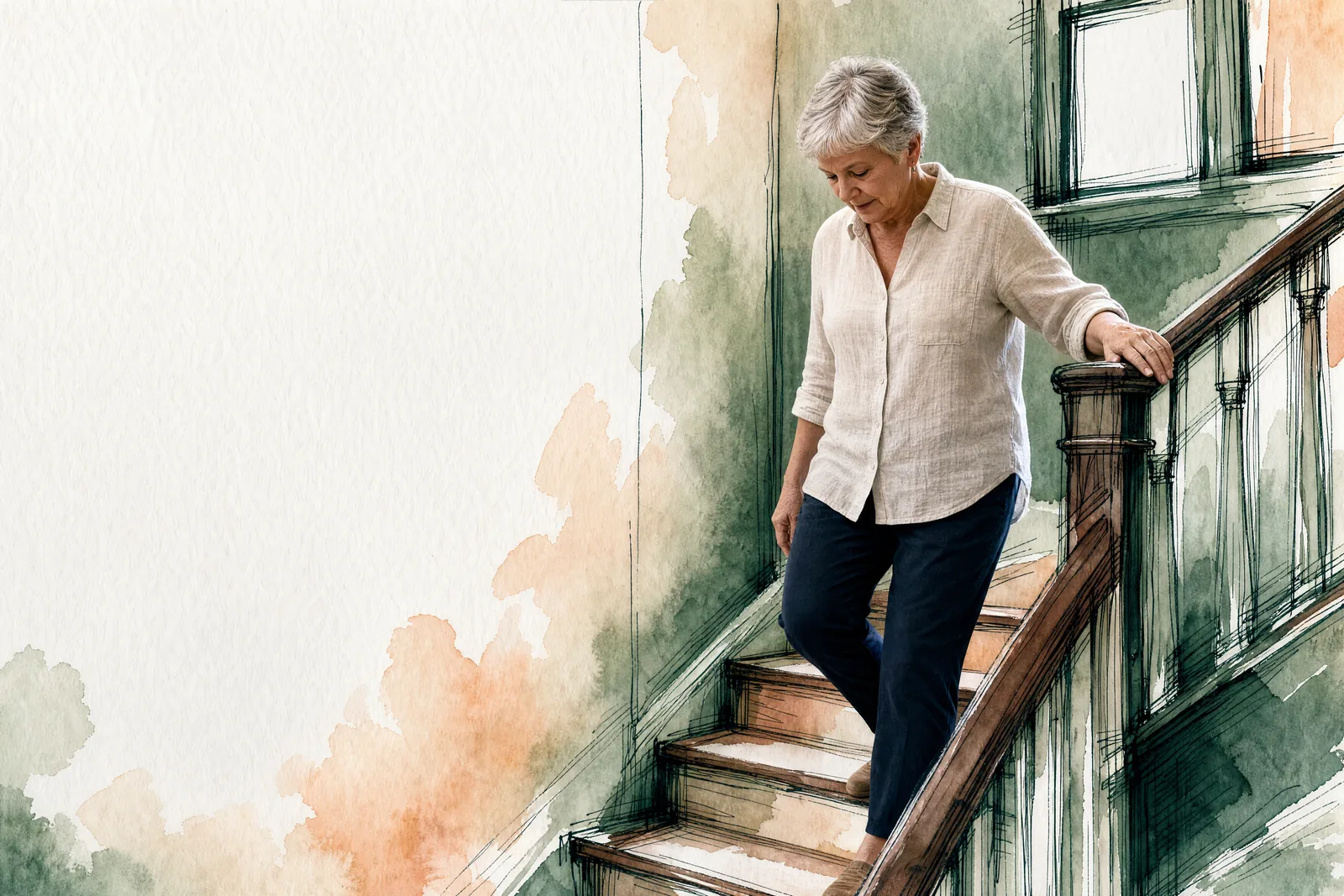
Tell your doctor about the hand you put out on the banister, twice in a week, even though nothing hurt and you never reached the floor. Feeling unsteady while the scale says you are lighter than you have been in years is worth raising, and the appointment is also the place for a short leg-strength test. Most advice on falls is written for older adults, and that test compares results only from age 60.
Does catching yourself count?
Yes, as something to tell your doctor. More than one in four older people fall each year, and fewer than half tell their doctor. Falling once doubles the chance of falling again, so an early warning is worth mentioning before there is a fall to report.
A fall, even one that did not hurt, can point your doctor to a new medical problem, or to something about your medicines or eyesight that can be put right, and your doctor may suggest physical therapy, a walking aid or other steps to prevent the next one. Feeling weak or unsteady is worth raising too: if you are feeling general weakness, talk with a doctor, because it could be related to sarcopenia or another medical condition. When you book the appointment, note how many near-misses there have been, where they happened, and what you were doing each time.
The chair test your doctor can run
Clinicians use a 30-second chair stand to test leg strength and endurance, standing next to you for safety while you do it, so ask your doctor to run it at the appointment. It needs a chair with a straight back and no armrests, and a stopwatch, and you will be asked to:
- Sit in the middle of the chair.
- Cross your hands at the wrists, each on the opposite shoulder.
- Keep your feet flat on the floor.
- Keep your back straight and your arms against your chest.
- On "Go", rise to a full standing position, then sit back down again.
- Repeat for 30 seconds.
The score is how many times you come to a full stand in the 30 seconds, and being more than halfway up when time runs out counts as a stand. If you need your arms to stand, the test stops there and the score is 0.
A below-average score indicates a risk of falling. What counts as below average depends on age and sex, with comparisons starting at 60, and the form your doctor scores it on has a row for each age group up to 94. Ask for your score and write it down with the date, so the next test has something to compare against, and take your notes on the near-misses to the same appointment.
What else makes a fall more likely
Weak leg muscles are one. Lower body weakness is one of the risk factors for falling that can be changed. Sarcopenia, a decline in muscle mass, strength and function, has been connected to weakness, tiredness, lower energy, and difficulty standing, walking and climbing stairs, and poor nutrition and lack of exercise can increase the odds of developing it. That is a reason to ask about strength when you tell your doctor about the near-misses.
Other changeable risks include difficulty with walking and balance, too little vitamin D, vision problems, foot pain or poor footwear, home hazards such as broken or uneven steps and throw rugs, and some medicines, including some sold without a prescription, that affect balance. Most falls come from a combination of risk factors, and the more a person has, the more likely a fall.
There are more besides, among them eyesight, hearing and reflexes that might not be as sharp as they were; conditions such as diabetes, heart disease, or problems with the thyroid, nerves, feet or blood vessels that can affect balance; and blood pressure that drops too much when you get up from lying down or sitting. Find out the side effects of every medicine you take, and tell your doctor or pharmacist if one makes you sleepy or dizzy. Have your eyes and hearing tested too: even small changes in sight and hearing are linked to a higher risk of falling. Bring a list of your medicines to the appointment, and the date of your last eye test.
If you feel unsteady when you walk, a cane or walker can help, and used correctly it can help prevent falls. If your doctor suggests one, make sure it is the right size for you; if you borrow one, ask your provider to check its size and that it is safe to use.
The kind of exercise that helps balance
Each week, older adults are advised to do activity that combines balance training with aerobic and muscle-strengthening work, and for adults the aerobic part is at least 150 minutes of moderate activity. How hard to push depends on your own fitness, and anyone with a chronic condition should find out whether and how it affects being active safely. If a chronic condition means you cannot manage those 150 minutes, the aim becomes being as active as your abilities and condition allow.
Yoga, Pilates and tai chi can all improve balance and muscle strength, and lifting weights or using resistance bands builds strength. Mild weight-bearing activity, such as walking or climbing stairs, may slow bone loss from osteoporosis. Healthy bones will not necessarily prevent a fall, but if you do fall they may help prevent a serious injury, such as a broken hip, and enough calcium and vitamin D, staying active, not smoking and limiting alcohol can all help keep them strong.
It may be tempting to do less after a scare, and the fear of falling may lead many older adults to avoid activities such as walking or shopping. Staying active is important for keeping your body healthy, and it actually helps to prevent falls. Strength work belongs in that activity, on two days a week (see Strength work twice a week, and why it matters during weight loss).
If there is a next time, and you are on the floor
Prepare now: keep a charged cell phone or cordless phone with you at all times, so you can call 911 from the floor, and arrange daily contact with a family member or friend. An emergency response system is another option, a button on a necklace or bracelet that summons help when pressed, and some smartwatches have the same feature.
If you do fall, do this, in order:
- Take several deep breaths and stay still for a few moments, to get over the shock.
- Decide whether you are hurt before you move, because getting up too quickly or in the wrong way could make an injury worse.
- If you think you can get up safely without help, roll onto your side and rest while your body and blood pressure adjust.
- Slowly get onto your hands and knees, and crawl to a sturdy chair.
- Put your hands on the chair seat and slide one foot forward so it is flat on the floor, keeping the other knee on the floor.
- From that kneeling position, slowly rise and turn to sit in the chair.
If you hit your head when you fall, see your doctor right away to make sure you do not have a brain injury; head injuries can be very serious, especially for people taking certain medicines, such as blood thinners. If you are hurt or cannot get up on your own, ask someone nearby for help or call 911. If you are alone, get into a comfortable position and wait for help to arrive.